Joshua Bell, inexorabletash@gmail.com
In scanning the Star Trek Chronology and Star Trek Encyclopedia, it is apparent that not all ships can be accounted for by known starship classes. The time period from 2196 to 2245 features a number of exploratory missions, but no starship designs from that era are detailed by canonical sources. However, by looking at the evidence presented, it is possible to reconstruct the design of those ships, given a few basic assumptions.
For the purposes of this reconstruction, I have assumed the following:
The Declaration-class was the Federation's primary vehicle of operations from 2196, when the Daedalus-class was withdrawn from service, until 2245, when the Constitution-class came into use. Noted ships of this class were the U.S.S. Valiant, lost in 2217 and the SS Columbia, lost in 2236. Typical missions included exploration, research, and first contact.
After the introduction of the Constitution-class, ships of this type were relegated to exploration and training duties. Known ships include the U.S.S. Republic NCC-1371, in service in the 2250s, and the SS Beagle, lost in 2261.
The Declaration-class was equipped with warp drive, but a relatively primitive design known as the "Stardrive", giving the class its alternate name of a Class-IV Stardrive type ("Bread and Circuses" [TOS] - The Beagle was a Class-IV Stardrive vessel). Matter/antimatter engines were not yet in use aboard starships at that time, severely limiting the capabilities of the ship. A fusion/fission reactor core provided the plasma needed to power the Warp Drives. ("Court Martial" [TOS]- Finney left the atomic matter piles aboard the Republic open) Some time between 2236 and 2254, matter/antimatter engines came into use ("The Cage" [TOS] - "We've broken the time barrier!").
Long range subspace radio had not yet been invented during the initial years of the Declaration-class' service. While short range subspace radio was used to conduct the negotiations ending the Romulan Wars ("Balance of Terror" [TOS]) in 2161, conventional radio signals were still used to report back to the Federation in 2168 ("A Piece of the Action" [TOS]) aboard Daedalus-class ships, and as late as 2236 when the SS Columbia was lost.
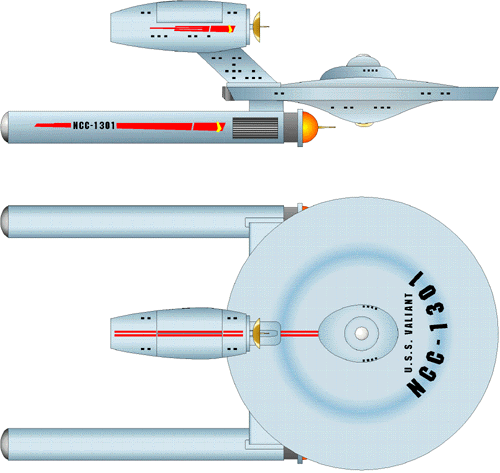
Physically, the ship resembled an inverted Constitution-class vessel, with a large saucer-shaped primary hull housing the main bridge, sick bay, engineering, and crew quarters. Near a sensor dome on the ventral surface were two ball-turrets for shipboard lasers ("The Cage" [TOS], "Obsession" [TOS] - phasers were not yet in use) and a photon torpedo launch tube ("If Wishes Were Horses" [DS9] - Vulcans had photon torpedo technology in the 22nd century). The bridge was positioned on the dorsal surface of the saucer. The computers were pre-duotronic in design ("The Ultimate Computer" [TOS] - duotronics were not invented by Daystrom until 2243).
The crew complement was approximately 75, plus or minus 25 depending on the mission ("Bread and Circuses" [TOS] - The Beagle had a crew of 47). Engineering was located just forward of the impulse drives, which themselves were at the aft end of the primary hull. The fission/fusion reactor cores were located here, and conduits transferred plasma to the warp drives, and the navigational deflector on the secondary hull.
Two under-slung warp nacelles connected by small pylons to the primary hull. The warp nacelles were slightly more advanced than those of the Daedalus-class; individual field coil segments were not visible, and the entire nacelle was encased in a protective outer layer. A Bussard hydrogen collector extended from the front of each nacelle, and just behind it were a number of vents for flushing reactor waste materials.
A short dorsal rose from the primary hull, angled back above the warp nacelles, and supported a small secondary hull. The upper surface would clamshell open, similar to the cargo bay of the old NASA Enterprise-class orbital shuttles, to allow the 2 standard shuttlecraft entry and egress, as well as permit easy loading of cargo. On the forward surface, a golden dish acted as navigational deflector. Because of the dangerous and unstable nature of fission fuel, it was also kept in this part of the ship - a precursor to the antimatter bottles of later generations of starships.
Later research has revealed that early Oberth-class starships have registry numbers in the 600+ range. Assuming that registry numbers at least roughly correspond to date, this means that Oberth-class starships predate the Constitution-class ships by a wide enough margin to partially "plug the hole" the Declaration-class was designed to fill. But that shouldn't stop good, honest speculation.
The modular design of the Declaration-class lends itself to speculation that some ships of this class were later refit to Constitution-class specifications. Suppose that the U.S.S. Constellation NCC-1017 was one such ship - it had a much lower registry number than other Constitution-class ships, and due to being a much a cheaper model, looked somewhat different than the Enterprise. This indicates that a range of registries from about NCC-1000 to NCC-1400 would be used by Declaration-class vessels.
Now, knowing that Starfleet's designers are primarily human, it stands to reason that a revolutionary ship (for its time) would be given an extraordinary registry number. Thus, U.S.S. Declaration NCC-1000. This yeilds the following list:
| Name | Registry | Notes | Fate |
|---|---|---|---|
| U.S.S. Declaration | NCC-1000 | Class ship (2190s) | Unknown |
| U.S.S. Constellation | NCC-1017 | Exploration? | Refit (2240s), Destroyed (2260s) |
| U.S.S. Valiant | NCC-???? | Exploration (2210s) | Destroyed above Eminiar VII (2217) |
| S.S. Columbia | NCC-???? | Exploration (2230s) | Crashed on Talos IV |
| U.S.S. Republic | NCC-1371 | Training (2250s) | Unknown |
| S.S. Beagle | NCC-???? | Survey (2260s) | Scuttled above planet 892 IV (2261) |
Another potential gee-whiz: first contact with the Klingon empire took place in 2218, well within the time frame when the Declaration-class was in service. Maybe one of these ships was responsible for that disaster, which lead to the creation of the Prime Directive. Maybe the Klingon D-7 cruisers borrowed the drop-down nacelle configuration from a captured ship of this class?
These are in chronological order. The design has evolved over time - pay attention to the secondary hull.
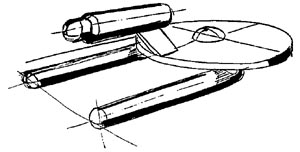
One of Matt Jefferies' preliminary design sketches for the Enterprise, from The Making of Star Trek (pg. 83):
Initial ASCII art rendition, by Joshua Bell:
  _,--------,                               .-.
 (_|        |(-                            ((_))
   `----\--\'    _-_                        >-<
        _\__\---'---`---.___        ___.---'---`---.___
        \----._________.----`      '----._________.----`
 ____________/_/_---'               _/     `---'     \_
(____________===|)-                (_)               (_)

 _____________.-------._
(__________.'         - `.
          /           o   \
         /            m    \
  _,--------,    ,-,  -     |
 (_||------||   | O |       |
   `--------'    `-'  U     |
         \            U    /
 _________\           Z   /
(__________`._         _.'
              `-------'
|
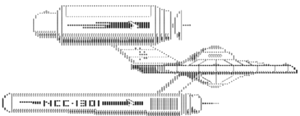
From insanely great ASCII art by Jeff Findley:
CAD Renderings byBernard Guignard:
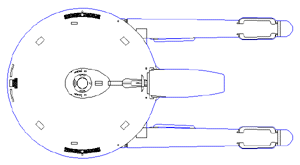 Top Plan | 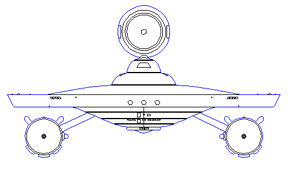 Forward Profile |
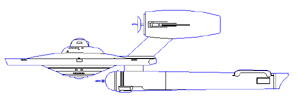 Port Profile | 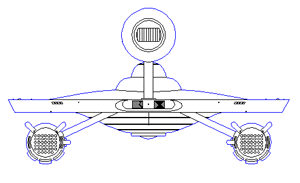 Aft Profile |
The requisite gradient-heavy rendition, by Joshua Bell
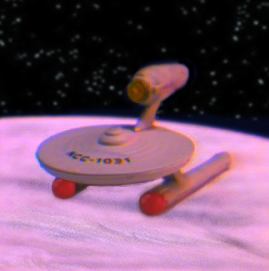
The image at the very top of the document is a photograph of a MicroMachines Classic Enterprise (about 80mm long) which was chopped up and put back together using Krazy Glue™.
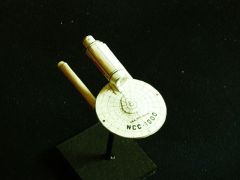
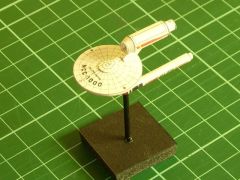
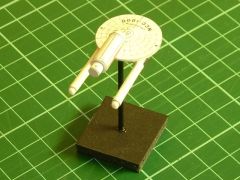
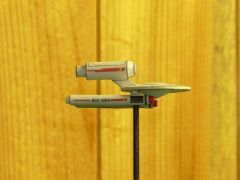
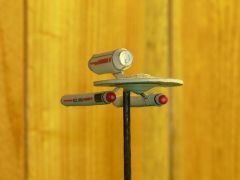
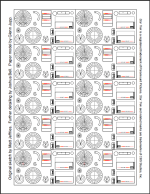
Make your own Declaration-class starship! Glenn Jupp of the Hamilton Road Gaming Group has created a papercraft model of the ship, which can be printed out on light card-stock and finished off with a couple of beads.
Glenn writes:
That's a centimeter grid on the mat so the model is about 4cm long, or an inch and a half. I'm planning to use it (and many others like it) in tabletop spaceship combat games.
Each ship fits onto a 3.5 x 2 inch business card, so you now have a decent little fleet.
No instructions yet, sorry. I used up a bunch of time selecting all the names and registry numbers (which I had done in a non-standard font) and turned them into polygons. But I would advise using bond paper if the model is going to be "look but don't touch." The light card I used made it difficult to roll up the tubes. But since mine will be for gaming, they need to stand up to some handling.
Also, I capped off the warp engines with little 2mm beads. At that scale, I am not folding geodesic hemispheres. Actually, I don't do that at ANY scale. I'm still new to this paper modeling thing.
And regarding the saucers, which are stacks of card discs:
I made a saucer sandwich using a bit of thicker card as the filling. It's that stuff comic book collectors put in the bag to keep their investments standing upright. About 1mm thick, perfect for what I needed.
Click the plans to download and print your own:
Since I first posted an early version of this document to the Internet in 1993 or so (as a plain text file with ASCII art), others have "taken up the cause" and routinely sent me renderings of the ship (like those seen above). I can't claim that either the design is original (after all, it's both a sketch by Matt Jeffries and an obvious rearrangement of the Constitution-class parts), or the name (the S. S. Enterprise seen as a background painting in Star Trek: The Motion Picture is labeled as Declaration-class in the Spaceflight Chronology), but it gives me a warm fuzzy feeling. Occasionally I run into renditions in random places on the Internet - people I've never heard of, who've probably never heard of me. Some of those sites are listed here:
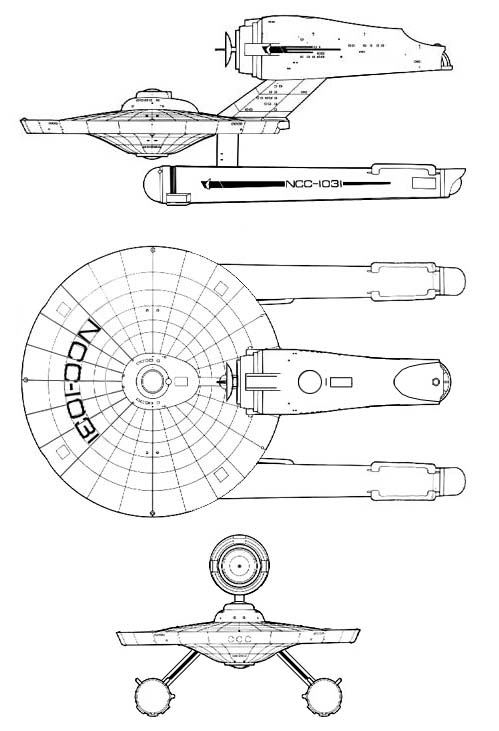
| The Ship
Schematics Database has a Declaration-class entry in the
U.F.P. and Starfleet Ships From The TOS Era page |
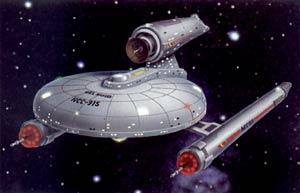
| The Star Trek RPG Core Rules Book by Last Unicorn Games includes
a Ranger-class ship with a very similar design. Steve Pugh has details
about it here:
|
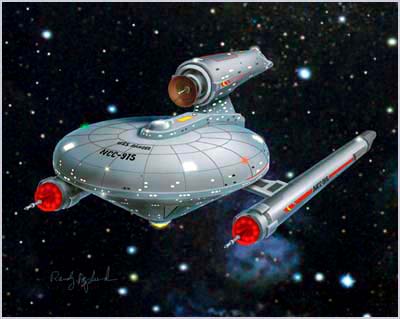
| Randy Asplund, the artist who drew the Ranger for LUG has the
following page with his original painting:
|